

Taking advantage of a day that has not rained much this Easter, we take the car to visit a castle that has always generated great stories and legends, which stands on an impressive cut on the river. Guadalete at Arcos de la Frontera and which was the scene for hundreds and hundreds of years of border battles between the Christian kingdoms and the Moorish kingdoms of Andalucía.

We have been really lucky because it is a castle that remains in private hands and we have been able to visit it thanks to the kindness of its owners, who in addition to showing it to us, were kind enough to tell us many stories about it.
It is also a castle that once belonged to the family of the Ponce de Leon and that at the beginning of the 20th century it passed into the hands of the present family. A predecessor of the current owners bought it when she found out that its destruction had been authorized because of the danger it represented. It had been completely abandoned for years. And this predecessor, being also of English origin and not Spanish, was dedicated since its purchase in body and soul to the complete recovery of the same. This has been followed with great affection and dedication by her descendants and I believe it deserves the praise of all those who enjoy it, even if only from the outside.
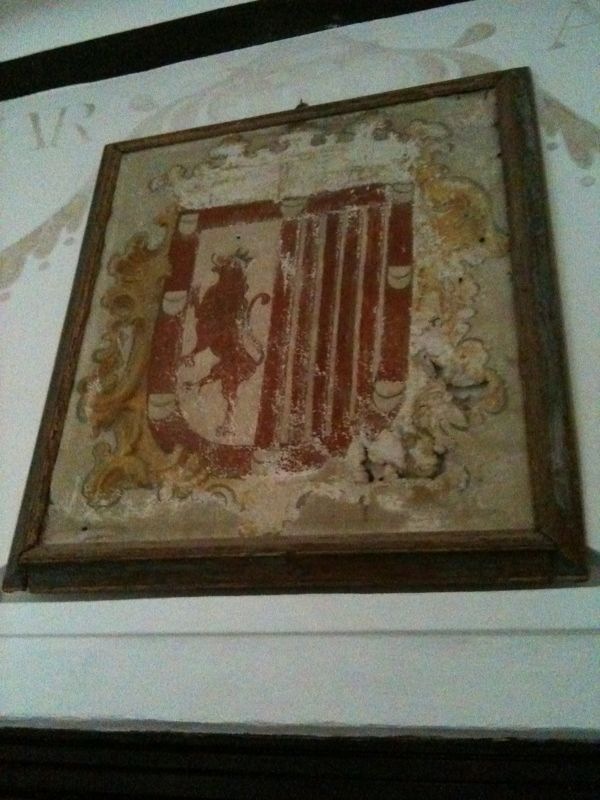
This is an image of the coat of arms of the Ponce de Leonoriginal owners of the castle, for whom the castle was created. Duchy of Arcos. They were great lords of the time, with important territories. In the map below, in light brown, you can appreciate their scope and size:

The area was a settlement of populations of much older cultures. Some pieces have been discovered in the castle that connect the site with the tartesosthe Romans and of course with the Arabs.
The views from the castle are truly spectacular. It is an impressive defensive watchtower, which is understood to have been used for so many years as a fighting and defense site.
The castle has a rectangular floor plan and had four crenellated towers at each of its ends, but only two remain today, the Tower of Homagebuilt by Don Rodrigo Ponce de Leónthe first Marquis of Cádiz and the first Ponce de León, lord of the castle, and the Tower of Secrecy.
A large cistern is preserved under the Courtyard of WeaponsThere are also three more cisterns and a door with a horseshoe arch, in what was originally the west entrance and probably the original entrance to the castle, but which is now walled up due to the reforms suffered over the years.
Arcos itself came to be constituted as a taifa kingdomuntil it was dominated by Al-Mutadidof Seville. In the thirteenth century it was won by the Castilians and then lost again until 1264. It was in the time of Alfonso X the Wise when it was finally taken to not cease to be, since then, Christian.
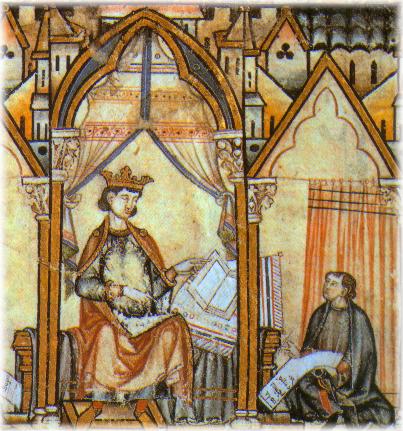
For hundreds of years Arcos was the border between the two kingdoms, hence the name that has accompanied it ever since.
Countless medieval legends are associated with the walls and passages of the fortress, such as that, referring to the conquest of Arcos by Alfonso X, which tells how the Christians used to take it from a hidden conduit that connected the castle with the Guadalete River, used at night by a beautiful Muslim lady, mistress of the town, to bathe in its waters, and therefore called "the bath of the queen". Another legendary story tells the story of the favorite of the Muslim kinglet of Arcos, who, after leaving on an expedition, would have left her locked up in the fortress with provisions to await his return, which never took place. She would remain forever a prisoner in the so-called "alcove of love", and it is said that the spirit of the unfortunate woman takes the form of a vulture that wanders among the battlements and the cliffs on nights when the moon is full.
Many of the inhabitants of Arcos talk about the dragon that is asleep inside the Arcos rockand that, when it wakes up, it makes the cliffs sound. In fact, the owner of the castle told us how he sometimes woke up at night to the roar of the earth beneath him.
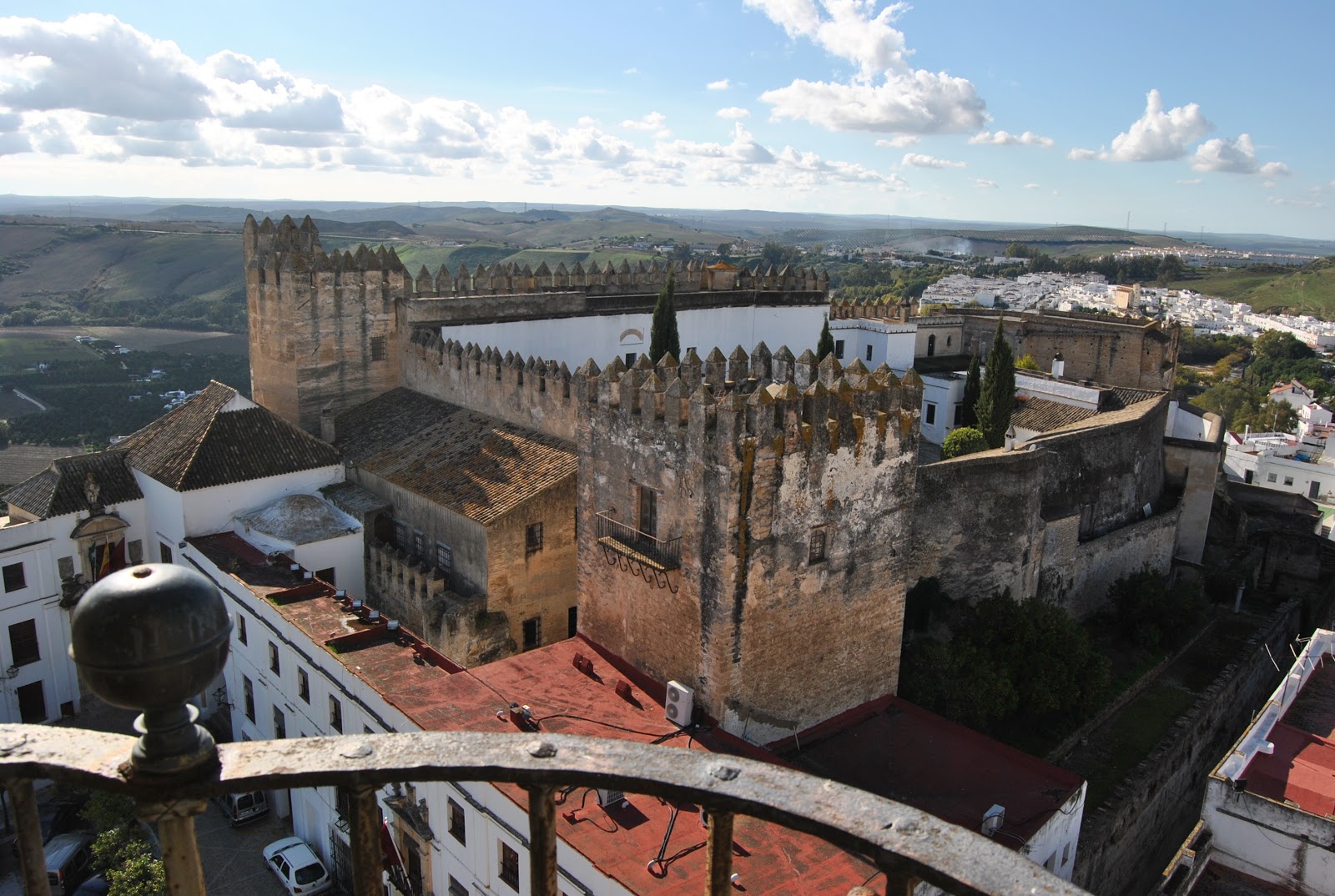
In the 18th century this castle had to be restored because of the Lisbon earthquake of 1755. One of the walls of the castle was completely collapsed, completely covering the moat surrounding the castle and giving rise to what is known today as the New Arcos Street. Two of its towers were also lost.
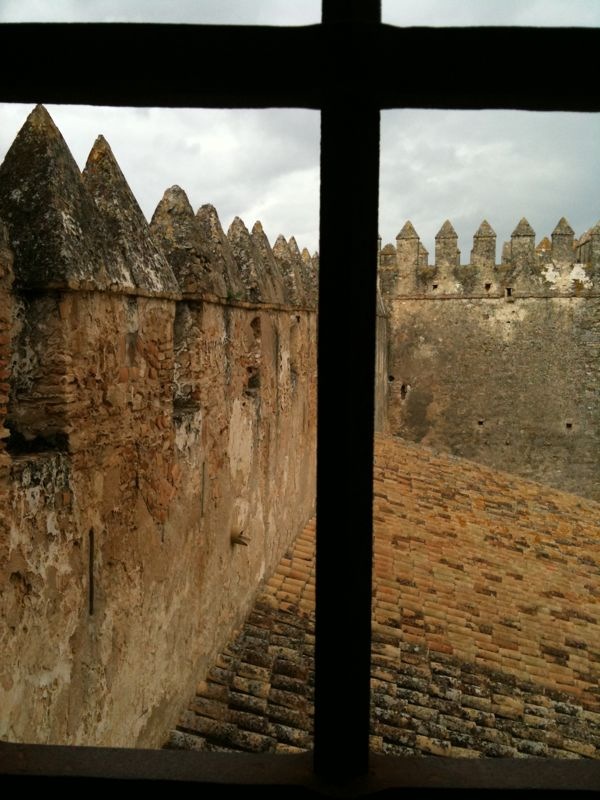
Time has passed since this visit to the Castle and I have met a person from whom I have had the opportunity to receive a very special gift and along with the gift, a very special and unexpected demonstration of friendship. He knew this post about the Castle of Arcos and offered me a text in which he narrated another legend of the Castle, which he wanted to read to me when he gave it to me. The beauty of the story, when I heard it from his own mouth, made me emotional at times.
This is his letter and the legend. I am sure you will enjoy it:
Dear Mr. Castillejo,
After reading your beautiful article on the Castle of Arcos, I comment on another legend that also takes us to the enchanted dreams of dragons and vultures. They say that the Vizier of Arcos, Lord of the Castle, sailed to the North and close to the lands of cold, boarded a Norwegian ship and caught a Nordic Princess with golden hair that was traveling on that ship. He was so impressed by the Princess as he got to know her that he returned with her to the love chamber of his fortress and promised not to subject her to his carnal desires until he had made her fall in love.
The Princess, little by little, languished with sadness. As the Vizier did not seem to succeed in his endeavor, he decided to release her in case the cause of her melancholy was his desire to love her.
With tears that shone like diamonds in the golden reflections of her hair, she opened her heart to him and confided that he was not the cause of her sadness. He had showered her with attentions and jewels and she dreamed in the hot Arcense summer nights of loving him, of having his jet hair caressing her long white legs, of feeling his moist lips caressing her skin and his feverish eyes penetrating her spirit. But it had to be on a bed of hay on the snow and see if it would melt or melt with the heat of her longing and desire, for that was how his mother told him, and his mother told her mother, what love was. "The man who possesses you, will melt the snow with his ardor, you will burn in his fire and you will burn together melting your lives between joys and sufferings.
"Snow!" cried the Wazir in despair.
So their captains set out with large trunks which they filled again and again, but when they reached the castle, they contained only a little water. "It is impossible, Lord, because of our climate" they stammered, fearful of his wrath. In desperation he summoned all the wise men of his domain, promising them great rewards, but they found no solution. Finally, Habibi the Orchardist undertook to satisfy his Lord's wishes if they would give him some time. He planted orange and almond trees in the Vega de Arcos, which can be seen from the Castle, bordering the Guadalete gorge, and when Spring came, a white miracle "Arcense snow" was contemplated.
They say that the Vizier and his Princess did not leave the room for thirty days and nights. They loved each other until the "Arcense snow" melted transforming into orange blossom and honey. For some time they were very happy and their domains and inhabitants were the happiest of the Kingdoms of Taifas. But some time later, the Barbarians encircled their lands. The Marquis of Cadiz and the Duke of Medina Sidonia attacked with their troops, trying to surround Arcos. The beautiful Wazir, with deep black eyes and jet-black hair, at the head of his troops and with the help of his uncle the Cadi of Zahara, tried to stop the barbarian advance in the foothills of the Sierra del Mujer Muerta, near Ben-mahoma.
In a moment the happiness broke into tragic despair. The body of the beautiful Vizier was wounded by an arrow, which pierced his chest. He was evacuated to his castle by his most faithful captains. The Princess of Thule, on seeing him, burst into a frenzy of pain at the river of blood flowing from the body of her beloved. With her hands she tried to stop it, but the hemorrhage would not stop and after mumbling to him how much she loved him, the Vizier's jet-black eyes went out, fixed on his beloved.
Reinforcements arriving from Cordoba and Malaga finally repulsed the barbarian forces. Like many other times, Arcos proved to be impregnable. Watchtower of the Arab territories, it is impossible to conquer. The attacking forces retreated to their territories.
They say that the golden-haired Princess, in desperation, threw herself into the void from the highest battlement of the Castle and in her fall was transformed into a beautiful black feathered bird, with flashes of gold. Even today it can still be seen on occasions how such a majestic bird flies along the rock and meadows of Arcos in search of the Wazir, or perhaps guarding its border.
Beautiful and beautiful story, thank you very much dear friend J.E.I.A.!
I am sure that all of us who are in love with Arcos de la Frontera, from now on, as we pass under the castle, will raise our eyes and look for the Princess who, transformed into a majestic bird, bears the sadness of the loss of the Wazir, but affirms and testifies of an imposing strength to grow in the face of difficulty.