

99% of the Spanish business fabric are small and medium-sized companies. In order for SMEs to maintain and grow, it is essential that they have financing available.
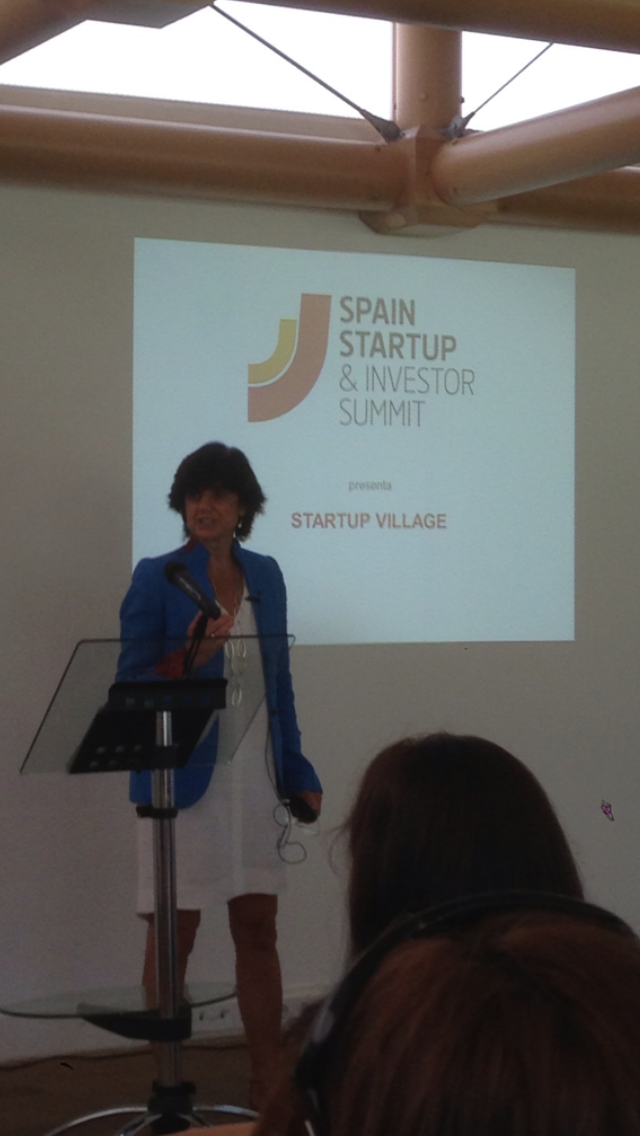
Yesterday I was at the press presentation of the Spain Startup & Investor Summit. An initiative promoted by the Instituto de Empresa and sponsored in a special way by Mutua Madrileña. Maria Benjumea, Chairman of the Board of Directors of Spain Startup and Chairman of the Board of Directors of Spain Startup, presented its activities in detail. Infoempleo.
The most important conclusions that were presented yesterday after analyzing more than 2,000 projects from all over Spain, are that access to financing, the entrepreneur's training and dedication to the project are determining factors for successful entrepreneurship in Spain.
Specifically, several points were mentioned that I consider important and worth highlighting:
- Two out of three projects do not have external funding
- Lack of credit means that only 2% of companies survive the 5-year period
- Global companies, with a greater international vocation, represent only 8% of the projects presented.
- 86% of the entrepreneurs are Spanish, which shows the lack of attraction of foreigners to the Spanish market.
- There is practically no entrepreneurial culture among people with secondary education or vocational training.
The need for small and medium-sized enterprises in Spain is evident. They represent 99% of the Spanish business fabric.
The secret to getting ahead as a country is not to talk about entrepreneurs. Nor is the secret in talking about supporting entrepreneurs. Not even in creating a "Law for Entrepreneurs".
The secret and the really key issue is that entrepreneurs and existing entrepreneurs, small and medium-sized companies, can find financing.
This is something that very few people talk about. The need to provide financing to companies.
Banks have completely closed the door to financing. They can't, they don't have the money or they simply don't want to. I don't know the answer. The reality is that financing has completely disappeared. And this is not a personal assessment. There are the statistics:

Well, if bank financing has disappeared... what alternatives are left to finance themselves as companies?
There are several. But the most important and the one that should be most accessible to companies is the ability to issue debt and place it in the market. Bond or debenture issues. Something that the Spanish State has been doing for a long time, as well as large companies, but which has been vetoed until now for small and medium-sized companies.
The SME bonds, being smaller issues and having for the investor the risk of a smaller size on the part of the issuing companies, obliges to place them at a higher price. This means a higher profitability for those who invest in them.
Opening this market would achieve two very important things from my point of view:
- This would solve the problem of financing, especially for SMEs. One of the most delicate Achilles heels for our companies, which means that only 2% of the companies survive to 5 years. But it is also...
- It would allow small investors to have access to investments with higher returns than those normally offered by banks. It is a syllogism based on the fact that the higher the yield, the higher the risk. Banks are paying at most 3% for deposited savings. SME bonds should be paying around 10%. I ask myself: What is riskier: a growing and internationalizing SME, or a Bank in Spain? To each his own. The reality is that today the small investor only has access to those things that go through the Banks. And the Banks only offer what they are most interested in .... the Banks.
Let's talk about issuing Bonds or Debentures.
On Friday last week, El Mundo opened its front page with this article:
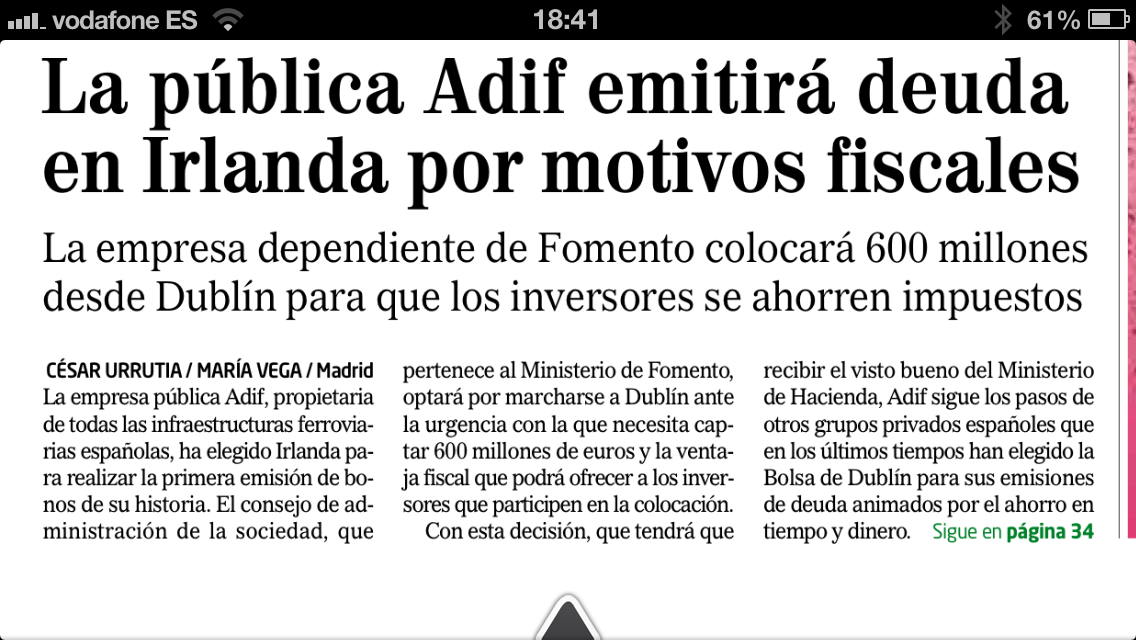
The three reasons that the journalist commented that they had been triggers so that ADIF had to go to Ireland!!!!! to issue bonds in order to finance themselves are:
- Time savingsADIF is in a hurry to raise money. This is the case for the vast majority of Spanish companies.
- Saving moneyThe costs of issuing in Ireland are much lower than those of issuing in Spain.
- Tax advantages for investors participating in the placement
It is important to keep this in mind. After the years we have had the credit tap completely closed, those who should be helping companies to gain access to credit seem to be looking the other way.
The journalist goes on to say that they have asked an investment bank to "with a strong presence in Spain"and this investment bank, among other things, claims that issuing debt in Ireland has a higher "administrative simplicity"than to consider doing so in Spain.

On the one hand, there is the "administrative simplicity"Ireland and on the other the Spanish exam with something similar to a ".trial"to analyze whether the risk inherent in the bond to be issued is "suitable or not"for the investor. In both the information is supposed to be the same and must be equally complete. In Ireland the process lasts three weeks and it is left to the investor to decide whether to invest or not. In Spain the process is exhaustive, complete, long, exhausting and lasts months.
Which of the two positions is the best? Is it really true that the Spanish investor does not have sufficient capacity to analyze the "?safety and security"What do you need to make an investment? This question should be answered.
Follow the article...
The journalist talks about two reasons that lead ADIF to seek broadcasting in Ireland:
- "...problems in accessing credit through the usual banking channels...". Bottom line: THERE IS NO CREDIT for companies. This problem of lack of credit could lead to the closure and death of most companies, exponentially multiplying unemployment in Spain. This is not a new problem. It has been latent for years in the Spanish market.
- "...speeding up issuance is vital for managers...". Speed is important for companies. If the Spanish state's financing were to be closed for eight or nine months, what would happen? We have already seen it in recent months. Spain would be on the verge of default and on the verge of intervention. But it seems that this is something that is not taken into account for companies. At least until now it has not been taken into account for SMEs. And now it seems that neither to the big ones. It is no longer only Corte Inglés who is going to Ireland to issue its bonds. It is also ADIF.
It is curious. It seems that Spain has become a country where it is better, easier, cheaper and faster to seek financing and official authorization to finance... in another country!!!!.

Follow the article...
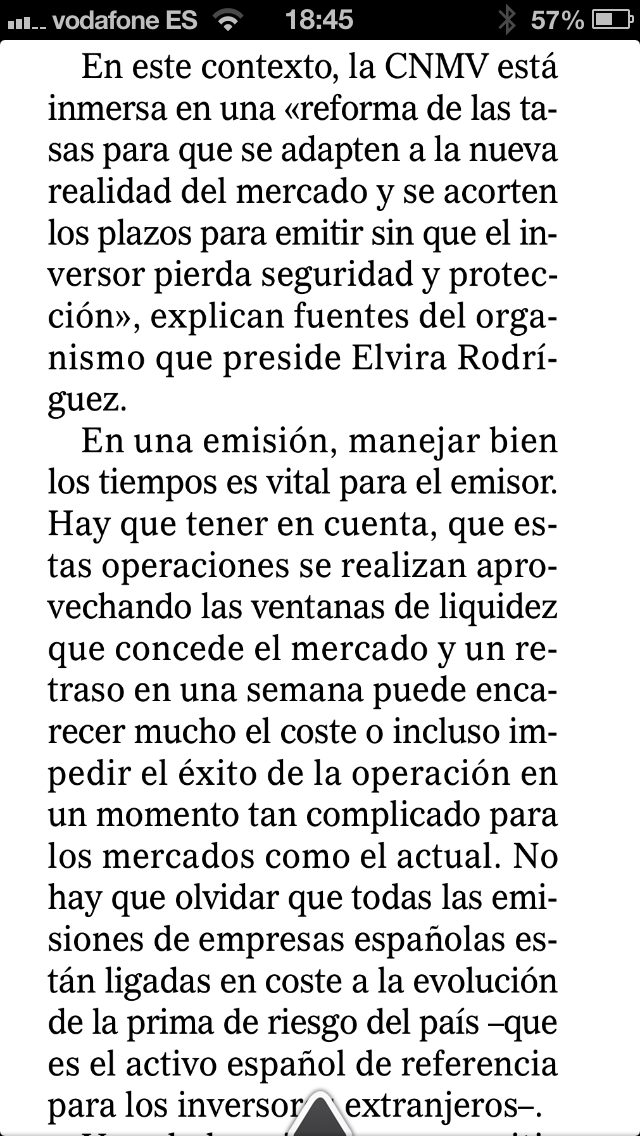
The journalist says that the CNMV "...is in the process of reforming fees to adapt them to the new market reality and shorten issuance deadlines...without the investor losing security and protection......"
I am sure and absolutely convinced of the honesty of the CNMV professionals in their desire to consider giving "a new impetus to the CNMV's work".safety and security"to the investor.
But... I wonder:
- Is the CNMV the one who should decide the security and protection that the investor should have? Shouldn't the investor be the one who can decide and choose the level of security and protection he/she wants? As far as I know, the CNMV should ensure that the information provided to the investor is complete and reliable. Complete information is "protection"for the investor. But I do not believe that it is among the objectives of the CNMV to ensure the "security"of the investor. If so, they would become co-responsible and I don't think that's what they're really looking for.. The investor must take care of his own safety.
- Does the investor need that the cost for the issuer, for the company issuing the debt, becomes very high because of the time to be spent, the requirement of additional documentation and clarifications, the cost of lawyers, etc. so that the CNMV can be sure that it is watching over this supposed "..."?security"Couldn't that become a huge risk for companies in today's times, when speed of reaction is essential for survival?
- Does the fact that the deadlines in this country are so long that it is better for issuers to seek approval in another country of the European Economic Community give security and protection to the investor? What are they doing wrong in Ireland or Luxembourg that allows them to obtain approval in weeks, while here it takes months?
- The recent experiences of many investors in Spain with investments in "supervised"...shouldn't they have sufficiently demonstrated that the control is not effective in who must approve the information given to the investor, but in who places and who finally decides whether to invest. or not? This is somewhat similar to tax increases. I think it is published in many places that if taxes are raised above a certain level, revenue decreases and economic activity comes to a standstill. This is what has happened in Spain. With bond issues something similar could happen: security is controlled by someone who I think should not do it and the conclusion is that corporate issues will never be sufficiently secure, especially while they spend months without being able to find the financing they need. While SMEs spend time and effort waiting for authorization, many could die of starvation. And in the best case scenario, instead of devoting their efforts and energies to what they are in the market for, they are forced to devote themselves to other things and not to developing their business. This makes us lose a lot of competitiveness, opportunities and agility to reach the market.
- Isn't it the unintended consequence of this desire to give "safety and securityThe "oligopoly" for financial institutions, so that what is being achieved unintentionally is that true competition never reaches the final investor? As long as the retail investor does not receive investment alternatives other than those proposed by the Director of his Bank Branch, or those that do reach him have to be on the list of "the best".investments approved for distribution"The banks will continue to control and filter what reaches the investor and, as is normal, they will do so according to their own interests. This is defined as oligopoly. There is no free competition. Where is Brussels for these cases? Why is Mr. Almunia not interested in this? The control exercised by the Banks over retail investors in Spain is total and absolute. It is practically impossible to place an investor in an investment product that the Regulatory Body and then the Banks do not like. Investors have very little capacity to decide. Everything comes to them "decaffeinated". As if they did not have the capacity to decide. And what is worse, that it reaches them".decaffeinated"is not necessarily in the interest of investors. However, it does seem to be in the interest of the banks.
I can't help but comment on something else, linked to the above, which I also find worrisome.
It seems that in view of the article on the ADIF issue in Ireland published last week in the paper version of El Mundo, the Socialist Parliamentary Group asked Minister Ana Pastor for explanations.
El Mundo said in the digital version that:
"…Rafael SimancasThe Socialist spokesman for Public Works, asked for explanations on two questions. "Firstly, it must explain why ADIF no longer turns to its usual provider of financing in recent years for large infrastructure projects: the European Investment Bank," he said.
In his opinion, the EIB "does not trust already in the very deficient analyses of demand and investment returns carried out by the new Fomento team in Spain".
Secondly, "Minister Pastor must explain how it is possible that a Spanish public operator such as ADIF has decided, according to journalistic reports, to issue its bonds in a foreign country, Ireland, with the explicit purpose of not paying taxes in our country".
From the reading of the text, it seems that the only thing that worries him is the Socialist Parliamentary Group is that a Spanish company, besides being public, but above all Spanish, has to "....issue its bonds in a foreign country, Ireland, for the explicit purpose of not paying taxes..."
What is understood from these questions asked by Mr. Simancas, or at least what I understand, is that the Socialist Parliamentary Group is only concerned about taxes.
According to the El Mundo article, Mr. Simancas states that the purpose of the "explicit" of the issue is not to pay taxes. And it requires Minister Pastor to explain how this is possible!!!!
I believe that Mr. Simancas is wrong in this respect.
The issuance of these bonds in Ireland has no ".the explicit purpose of not paying taxes"One of the purposes of the issuance, according to this same article, is to obtain tax advantages. But that is only the third one. Before that there are two other purposes that I think are much, much more important for ADIF:
- to be able to issue the financing it needs and to be able to
- cost reduction.
Mr. Simancas does not seem to be concerned about these first two purposes.
That it is necessary to go to Ireland to broadcast, because if we try to do it in Spain the deadlines would be so long that they would not arrive in time to meet their needs Mr. Simancas does not seem to be concerned about it. Nor does it seem to be concerned that it is it is evident how "cumbersome" - to use the words of the article - and expensive the process is in Spain..
This is how we are doing.
We need to be concerned about supporting companies so that they can have by hand real and effective solutions to the problems they face. And the biggest problem is access to financing.
If real solutions to this problem were offered, the immediate consequence would be that economic activity would be generated, growth would resume, wealth would be generated and, above all, new jobs would be created.