

A few days ago, I had the opportunity to attend a conference of the Professor Javier Paredes. The purpose of the conference was to talk about Marian apparitions throughout history. One of the most significant facts he commented on was what has ended up being the title of this entry: 80% of the apparitions of the Virgin Mary have occurred since the 19th century!
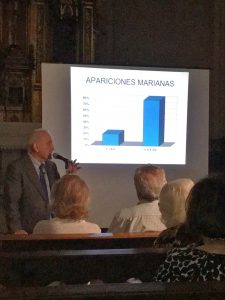
After thousands of years of history, curiously, it has been in the last one hundred and fifty years that the vast majority of the apparitions of the Virgin Mary have been concentrated.
In this regard, a small comment... it is thousands of years, but only a little more than two thousand since Mary, the mother of Jesus, lived and walked the earth. Before her own earthly life she could not appear. In fact, the first of her apparitions documented and accepted by the Church, as Professor Paredes told us, took place in Saragossa and occurred at a time when the Virgin Mary was still alive. On January 2, 40, she appeared to the Apostle Santiago while the apostle was in Zaragoza with his disciples, next to the Ebro River. Technically it was a bilocation, not an apparition. As I said, in those years the Virgin Mary was still alive. Surely in Ephesus in the house which was discovered a few years ago near the coast and has been visited by the last Popes of the Church.
James was one of the apostles whom Jesus appreciated the most. In the Gospels he is known as the son of Zebedee and Salome. He accompanied Jesus on the ascent to Mount Tabor, where the Transfiguration took place, and he also accompanied him in the Garden of Olives, while Jesus implored God shortly before his condemnation, torture and death process began. James was also the first of the apostles to be martyred: he died in Jerusalem, beheaded on Mount Calvary. He was an apostle who has always been especially close to Marian places.
He ordered to build a place of worship to venerate Mary around the pillar on which she appeared in Saragossa, in memory of the event. And that became the first Church in the world, consecrated to honor the memory of the Mother of Jesus. When she appeared to them, Mary, speaking of the place, told them:
"this place will remain until the end of time so that the virtue of God may work wonders and marvels through my intercession with those who in their needs implore my patronage."
During the Spanish Civil War the church was bombed. None of the bombs exploded when they hit it. Those bombs are still there in memory of that day.
On December 9, 1531, San Juan Diego was on his way to a church built by Hernán Cortés on the ruins of Aztec temples and consecrated in honor of St. James the Apostle, when the Virgin Mary appeared to him. Virgin of Guadalupe.
And the Church of Medjugorje is also dedicated to St. James the Apostle. It seems that a series of apparitions of the Virgin Mary are finally about to be approved there and in the meantime, many conversions have been taking place around that Marian Shrine for years.
But back to our original thread... the 80% of Marian apparitions have occurred since the mid-19th century.
What causes this "inflation of appearances"of the Virgin Mary, if you will pardon the expression?
Professor Paredes, as a good professor of history, used it and the various events to try to explain his theory of why this has happened:
- The foundations of Christian education. The Catechism in its First Chapter, Article 1 says: "I believe in God the Father Almighty, Creator of Heaven and Earth.". The Christian believes in God and believes that this world has been the object of God's creation. And in Chapter Three, entitled I Believe in the Holy Spirit, Article 9 says: "I believe in the Holy Catholic Church". "750 Believing that the Church is "Holy" and "Catholic", and that it is "One" and "Apostolic" is inseparable from faith in God, Father, Son and Holy Spirit.".
- Luther questioned submission to authority. In his writing "Christian Freedom"of 1521, defended that man has the capacity to choose"....a Christian is subject above all to the Lord and to no one else but the Lord, including the writer....". Luther wrote this text in response to the bull papal Exsurge Dominewhich he had publicly burned in December 1520, in which he was urged to abjure within 60 days of 41 de The 95 theses from Wittemberg. Chamberlain Karl von Miltitz of Saxony attempted to mediate in the conflict between Luther and the papacy by sending a letter to the Pope Lion X . In the letter he added a copy translated into Latin of Christian freedom. A few months later, Leo X promulgated the bull Decet Romanum Pontificem in which he excommunicated Luther and declared him a heretic, as well as anyone who followed his teachings. During the Middle Ages the Christianity had the power to establish a "holy orderAccording to the "God's will", according to which each person occupied a fixed place, predetermined by God. The Catholic Church possessed the power to establish this order according to his best judgment, and people had to submit to it. Only through this subjection and the fulfillment of many and varied formal obligations was the Christian a sharer in the salvation of the world. Jesus Christ. In this way, the Catholic Church exercised control over individual liberties, whose only consolation was a life in the Hereafter, next to God. Luther, who had made a detailed study of the Pauline Epistlesproposed a breakup of this "holy order"and the statements made by Paul of Tarsus:
- In order that we may know in depth what the Christian is and know in what consists the freedom that Christ acquired for him and of which he has made him a gift - as the Apostle Paul repeats so many times - I would like to establish these two affirmations: The Christian is free lord of all things and is subject to no one. The Christian is the servant of all things and is subject to all. Both affirmations are clearly stated in the epistles of Saint Paul. (...)
To the justification by works preached by the Catholic Church, Luther opposed justification by faith:
- No work makes the craftsman according to the quality of his work, but as the craftsman is, so shall the work be. The same is the case with human works, which will be good or bad according to the faith or unbelief of man. And not the other way around: as his works are, so will he be righteous or a believer. (...)
"Christian liberty." Luther's letter in reply to the Pope, is a milestone in the passage of the Middle Ages to the Modern Age because it proposes a reversal of the hitherto prevailing conception of the relationship between religion y freedom.
Already during Luther's own lifetime, his ideas were of great relevance for the unleashing of the German Peasants' War. What Luther had used in a theological sense was understood by the peasants in a literal sense: the liberation from the Vassalagewhich postulated in The twelve items. This led to the revolution of the peasantry against the feudal lords and the princes: the peasants, under unbearable tax burdens, demanded to be part of the decisions. The rebellion resulted in more than 100,000 deaths among the peasantry. The most important disaster in terms of human lives in Europe until the advent of the French Revolution. In view of the consequences of his theories, Luther rectified himself and said that the power of decision was only in the hands of the German Princes. Those who paid him. Luther distanced himself from the peasants' revolts with his writing of 1525 Against the thieving and murderous hordes of peasant farmers.
- December 27, 1673, the feast of St. John the Apostle, Margaret Mary Alacoquewho was only 14 months professed and 26 years old, was, as usual, kneeling before the Lord in the Blessed Sacrament exposed in the chapel of the Convent of the Holy Sacrament. Paray-Le-Monial where he had professed. It was then that the first great revelation that the Lord would grant her took place. She tells it like this: "While I was before the Blessed Sacrament, I found myself completely penetrated by His divine presence. The Lord made me rest for a very long time on His divine bosom, where He revealed to me all the marvels of His love and the inexplicable secrets of His Sacred Heart. He said to me:"My Divine Heart is so impassioned with Love for men, particularly for you, that, not being able to contain the flames of its ardent charity within it, it is necessary for it to pour them out, making use of you and manifesting itself to them in order to enrich them with the precious gifts that I am discovering to you, which contain the sanctifying and salutary graces necessary to separate them from the abyss of perdition. I have chosen you as an abyss of unworthiness and ignorance, in order that it may be all my doing." "Then," Margarita continues, "he asked me for my heart, which I begged him to take and which he did, putting me then in his adorable one, from which he made me see it as a small atom that was consumed in the burning furnace of his, from where he took it out as a flame lit in the form of a heart, putting it next in the place from where he had taken it, saying to me at the same time: "Behold, my well-beloved, a precious garment of my love, which encloses in your side a spark of its most lively flames, so that it may serve you as a heart and consume you to the last instant, and whose ardor will neither be extinguished nor cool. In such a way I will mark you with the Blood of My Cross, which will bring you more humiliations than consolations. And as proof that the grace I have just granted you is nothing imaginary, although I have closed the wound in your side, its pain will remain in you forever, and if up to the present you have only taken the name of my slave, now I give you that of beloved disciple of my Sacred Heart." After this great favor, Marguerite remained for many days as if completely burned and intoxicated and so out of her mind that she could only speak and eat, doing great violence to herself. She could not even share what had happened with her superior, which she had a great desire to do. Nor could she sleep, for the sore, the pain of which was so pleasant to her, generated in her such intense burning that it consumed and burned her all over.
From the first revelation, Marguerite would suffer every first Friday of the month a reproduction of the mysterious sore on her side, something that would happen until her death and that was rigorously verified by ecclesiastical authorities who for many years did not want to trust her and her manifestations.
In June 1685during one of the apparitions, Marguerite was given the mission of to ask the King of France to consecrate his country to the Sacred Heart of Jesus. and to represent him on the banners of the Kingdom.
"Make known to the eldest son of My Sacred Heart (King Louis XIV), that just as his temporal birth was obtained by devotion to the merits of My Holy Infancy, so also his birth to eternal glory be obtained by his consecration to My adorable Heart. My Heart wants to reign in his palace, to be painted on his banners and engraved on his weapons in order to obtain victory over all his enemies and those of the Holy Church. My Father wants to make use of the King to execute his plan, which is the construction of a public building in which the picture of My Heart will be exhibited to receive the homage of all France. My Heart wants to reign in his palace, to be painted on his banners and engraved on his arms to obtain victory over his enemies and those of the Holy Church."

After requesting an audience with King Louis XIV, on June 17, 1689, the nun came out of her enclosure and conveyed her message to the King. The French King, at the height of his power after 46 years of reign, turned a deaf ear to the request expressed by the young nun.
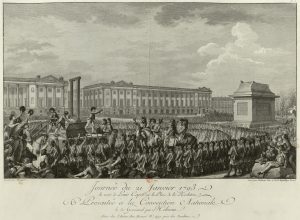
Exactly one hundred years later, the June 17, 1789On the Feast of the Sacred Heart, the Third Estate proclaimed the constitution of the General Assembly, from which the revolution that would wage a fierce struggle against the Church, the monarchy and the Christian tradition of France would take shape. Three years later, on January 21, 1793, the head of Louis Capet, the great-great-grandson of Louis XIV, known as Louis XVIfell into what is known today as the Place de la Concorde.

The French Revolution drew its inspiration from the ideas of Adam Weishaupt (*1748 †1830), a former German Jesuit, founder of the order of "The Perfectibilists," a branch of the Freemasonry better known as the Illuminati. One of the forgers of the anarchism and of the Masonic plot that laid the foundations for the political movements that gave rise to the independence of the United Statesin addition to the French Revolution and the emancipation of many European colonies. Likewise, Weishaupt is considered one of the greatest exponents of the atheism and, according to the writer John J. Robinson, as the greatest conspirator of all times. His theory was that there is a rational enlightenment, outside and above faith, accessible to anyone and capable of leading to a higher perfection. He died disavowing his Catholic faith.
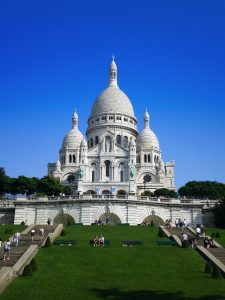
It would have to wait until 1870 - Napoleon III's declaration of war on Prussia following the unsuccessful annexation of Luxembourg by the stubbornness of Otto Von Bismarckwho refused to keep his word to the French Emperor, known as the the Franco-Prussian war and which led to the creation of the German Empirethe defeat of the French army in the battle of Sedan the occupation of part of the country by German troops and the end of the Second Empire of Napoleon III - so that Alexander Legentilwho had been a deputy of Louis Philippe and his brother-in-law, the painter Hubert Rohault FleuryThe first time in the history of the French Republic, they made a vow to build a church dedicated to the Heart of Jesus, to atone and repent for the sins committed by the French. On September 4, 1870, the day of the declaration of the Third Republic in France, Msgr. Felix Fournier attributed the fall of France in the Franco-Prussian war to divine punishment after a century of moral neglect following the revolution of 1789. That led Alexander Legentil, one of the Governors of the Bank of France, an important businessman and a fervent Catholic to publish: "To make reparation for our offenses, to obtain from the infinite mercy of the Sacred Heart of our Lord Jesus Christ, the forgiveness of our sins, and extraordinary succors, with which alone can free the Supreme Pontiff from his captivity and stop the miseries of France, we commit ourselves to contribute to the construction in Paris of a sanctuary dedicated to the Sacred Heart of Jesus." They built in Montmartre the Basilica of the Sacred Heart.
 During World War I, in response to the request of St. Margaret Mary, more than twelve million French flags and pennants were adorned with the Sacred Heart of Jesus and so were carried by soldiers of the regiments. In 1917, the Republic prohibited the individual consecration of soldiers to the Sacred Heart and the wearing of insignia.
 - After the experience of the French Revolution, various movements began to take shape and gain strength in the Western world, obsessed with putting man at the center of history and displacing God. The French themselves went so far as to change the names of the months, years and weeks with the sole objective of making God and the Church disappear from the heads of the citizens. In order to avoid any temptation for people to think of the transcendent, it was even decreed that death was over and that from that moment on, we would only speak of sleep. Napoleon, after deceiving for a time the envoys of the Pope, invaded Rome, made the Pope Pius VI prisoner and sent him into forced exile. When he died in Valence-sur-Rhône (France), the prefect of the locality registered in the death register: "Citizen Braschi, who worked as a pontiff, passed away". Many newspapers and gazettes in Europe sentenced the Church and the papacy by headlining on the front page: "Pius VI and last". Man had become the center. God had been taken out of the picture.
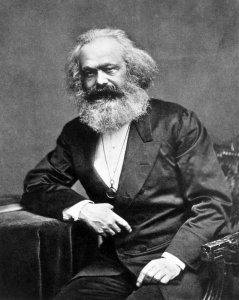
- The Marxism, is the theoretical explanatory model of reality composed mainly by the thinking developed in the work of Karl MarxThe German revolutionary economist, philosopher and journalist of Jewish origin, who contributed in fields such as sociology, economics, law, and history, as well as the series of thinkers who complement or re-interpret this model, a tradition that goes back to Marx's co-editor, Friedrich Engelsto other thinkers such as Lenin, Leon Trotsky, Rosa Luxemburg, Antonio Gramsci o Georg Lukács.
 It is therefore a current of thought. The word "Marxism" is mistakenly associated with the set of political and social movements that emerged during the 20th century, among which the Russian Revolutionthe Chinese Revolution and the Cuban Revolution. For these social movements the correct name is "communism" o "socialism". It is incorrect to pose these movements as synonymous with ".Marxism"because neither its entire human component nor its entire political doctrine was based on Marxism as such.. Engels coined the term scientific socialism to differentiate Marxism from the currents socialists previous ones included by him under the term utopian socialism. The term Marxist socialism to refer to the specific ideas and proposals of Marxism within the framework of socialism. He came to deepen the same foundation: man became the center. With his very concrete and well-known interpretations, which are not necessary to detail here, in the base and in the definition of Marxism there is only the human being and the disappearance of God.
- The class struggleThe development of the media and the evolution of society towards the end of contradictions and the end of the exploitation of the environment were favored. man by man: it lays the foundation for communism.
- Critique of the capitalist economyThe Marxist hypothesis would prove that in reality capitalist society is founded on the theft of human labor through the concept of "...".capital gain"legitimized in the rule of law through private ownership of the means of production and the free usufruct of those profits.
- Ideologythe concept of "commodity fetishism"which would be a way of explaining a person's psychological inability to perceive the "use value" of a commodity.
- CommunismTheoretical and utopian human society that can surpass the limits of the capitalist society formed in human exploitation.
- Marxism began in 1840 but became strong with the movements it inspired in the 20th century. With the turn of the century, it seems that the Virgin Mary's focus on the recipients of her apparitions also changed almost across the board. In that first twenty percent of apparitions - perhaps with the sole exception of St. Juan Diego - the apparitions had been to great men and women of the Church, mystics, future saints and, on many occasions, with high degrees of formation. However, from the 19th century onwards, they are apparitions to the most humble people and in most cases to children to whom the Virgin Mary entrusts great secrets and truths that they could not have known beforehand.In this sense, it is especially important the apparitions of the Blessed Virgin Mary to the most humble people. apparitions of the Virgin Mary in Fatima in 1917: how he explains to uneducated little shepherds what was happening in the world and what would happen shortly afterwards. An amusing detail: Francisco, the little shepherd boy, when he was told that the Virgin Mary was talking about Russia - he could see the Virgin Mary but could neither talk to her nor listen to her - he thought she was referring to the donkey of one of the villagers who was known as "Russia". They did not know that Russia was a country far away from where they were. In August 1931, due to an illness, Sister Lucia was spending some time in a friendly house in Rianjo, Spain, a small maritime town near Pontevedra, to rest and recuperate. It was in the chapel there that the Messenger of Fatima was once again to receive a communication from Heaven. Our Lord complained to Sister Lucy about the tardiness of His ministers, who were delaying the Consecration of Russia to the Immaculate Heart of Mary, as the Virgin Mary had requested at Fatima on June 13, 1929, two years and two months earlier. Sister Lucy informed her bishop of the important revelation:
Bishop, my confessor asks me to share with you what recently happened between me and Our Good God: asking God for the conversion of Russia, Spain and Portugal, it seemed to me that His Divine Majesty said to me:
You console me much by asking me for the conversion of these poor nations. Ask it also of my Mother, saying many times: Sweet Heart of Mary, be the salvation of Russia, of Spain and Portugal, of Europe and of the whole world.
And at other times: by your pure and Immaculate Conception, O Mary, obtain for me the conversion of Russia, of Spain, of Portugal, of Europe and of the whole world.
'Make it known to My ministers that, since they follow the example of the King of France in delaying the execution of My request, they must also follow it in affliction. It will never be too late to have recourse to Jesus and Mary.’
In another text she wrote,
Later, through an intimate communication, Our Lord said to me, complaining:
They have not wanted to heed My request... Like the King of France they will repent, and they will do it, but it will be too late. Russia will have already spread her errors throughout the world, provoking wars and persecutions of the Church. The Holy Father will have to suffer much!'
Our Lord was making explicit reference here to the requests for the Sacred Heart made on June 17, 1689 to the King of France through St. Margaret Mary Alacoque. As a result of the refusal of King Louis XIV - as well as the refusal of both his great-grandson, Louis XV, and his great-great-grandson Louis XVI - to publicly consecrate France to the Sacred Heart of Jesus, the Masonic movements carried out the great uprising of the French Revolution in their purpose to revolutionize the way of understanding the world, life and the human being.
In Rianjo, Jesús warns that this dark chapter of history will repeat itself. It could be seen with World War II and also in the Spanish Civil War.
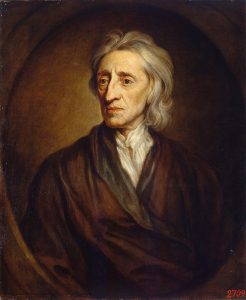
- The liberalism is a political philosophy that defends the individual freedomprivate initiative and limits the state intervention and public authorities in social, economic and cultural life. Likewise, it is identified as an attitude that advocates the freedom and tolerance in human relationships, based on the free will (vid. Salamanca School). It promotes, in short, the civil liberties y economic and opposes the absolutismto the enlightened despotismto the conservatismthe systems authoritarian, dictatorial y totalitarians. It constitutes the current on which both the Rule of law as the participatory democracy and the division of powers. In short, it maintains the same foundation as the previous movements: man is and must be the only center.Born at the end of the sixteenth century inspired by the writings and thoughts of John Locke (*1632 †1704) who proposed that sovereignty emanated from the people; that property, life, liberty and the right to happiness are natural rights of men, prior to the constitution of society.
 According to liberals, the state's main mission is to protect these rights, as well as the individual liberties of citizens. It also holds that the government should consist of a king and a parliament. The parliament is where popular sovereignty is expressed and where laws are made that must be observed by both the king and the people. Anticipating MontesquieuLocke, who was influenced by Locke, describes the separation of the legislative power and the executive. The authority of the State is based on the principles of popular sovereignty and legality. Power is not absolute but must respect human rights. It treats religion as a private and individual matter, affecting only man's relationship with God, not human relationships. By virtue of this privatization, man frees himself from his dependence on ecclesiastical impositions and removes confessional legitimacy from political authority, since he considers that there is no biblical basis for a Christian state. It is considered to be one of the first empiricists British. He followed the ideas of Francis Bacon and also played a fundamental role in the theory of the social contract. His work had a major impact on the development of the epistemology and the political philosophy. His writings influenced Voltaire y Rousseaumany thinkers of the Scottish illustrationas well as the American revolutionaries. His contributions to classical republicanism and the liberal theory are reflected in the Declaration of Independence of the United States.
Liberalism took a much more active form from the end of the 20th century and began a vertiginous growth in the 21st century. It is curious how in Europe it was possible to move from communism to the most radical liberalism without spilling a drop of blood and without a single shot being fired. In essence, they are very similar movements. One of the most obvious exponents of this apparently profound change, but at bottom so simple, is the current German Chancellor, Angela Merkela member of the Communist Youth of the GDR, and in 2015 recognized by Forbes Magazine as a the most powerful woman in the world. One of the most active champions of liberalism today.

 During World War I, in response to the request of St. Margaret Mary, more than twelve million French flags and pennants were adorned with the Sacred Heart of Jesus and so were carried by soldiers of the regiments. In 1917, the Republic prohibited the individual consecration of soldiers to the Sacred Heart and the wearing of insignia.
 It is therefore a current of thought. The word "Marxism" is mistakenly associated with the set of political and social movements that emerged during the 20th century, among which the
  According to liberals, the state's main mission is to protect these rights, as well as the individual liberties of citizens. It also holds that the government should consist of a king and a parliament. The
 The common thread of all these events lies in the obsession to consciously remove God from man's existence on Earth. The aim is to eliminate God from Creation and, in short, to eliminate his presence. It is a matter of denying his existence or making it completely alternative.
With this focus and this quest of the human being to become the center of the Universe, God the Father, God the Son and God the Holy Spirit are subjugated. The will of the human being to remove them from his life is exercised with total freedom. By virtue of the freedom given by itself to the human being, the Holy Trinity can do nothing to prevent it. God, being rejected, is bound by man without the capacity to be able to do anything.
This is what is known as the "sin against the Holy Spirit". The one sin that Jesus made clear could not be forgiven.
"whosoever shall speak a word against the Son of man, it shall be forgiven him: but whosoever shall speak against the Holy Ghost, it shall not be forgiven him in this world, neither in the world to come." (Mt 12:32)
"And whosoever shall speak a word against the Son of man, it shall be forgiven him: but whosoever shall blaspheme against the Holy Ghost, it shall not be forgiven him." (Lk 12:10)
Faced with this situation, what alternative is left for man to be able to remember that we are wrong?
Only the Blessed Virgin Mary. The Mother of Jesus. Our Mother in Heaven.
The best and only explanation as to why it has been in these last one hundred and fifty years that the Virgin Mary has lavished herself in the way she has done.
There is no time left now to talk about two important apparitions of the Virgin Mary in Spain.
One in the middle of the 19th century in Madrid to Sister Patrocinio, a novice in the Convent of Caballero de Gracia to whom the wounds of Jesus Christ first appeared in his Passion, or stigmas -Pio many years later - and shortly thereafter, in 1830, the Virgin Mary appeared to him under the title "....of Oblivion, Triumph and Mercies".
And a second one, very important for the continuity it has on the apparitions of Fatima, very little recognized both in Spain and outside Spain that took place in Santander, in the small village of San Sebastian de Garabandal four girls between June 8, 1961 and June 8, 1965. It is known as the Virgin of Carmen, from Garabandal. When the Virgin Mary at Fatima said goodbye to the shepherds, she said to them: "To San Sebastian, Spain". And so it was.
I will come back to them.